

What Is a Car Parking Lift and How Does It Work?

A Car Parking Lift creates more parking capacity without expanding a building’s footprint. It moves vehicles vertically, using platforms, guide rails, motors, and safety controls to place cars in stacked spaces. Picture a car easing onto a steel platform in a garage. With the operator’s controls, the platform rises or lowers, revealing another parking space beneath it. The movement looks simple. The engineering is not.

Different systems suit different sites. A two-post lift may serve a home garage, while a larger automated system can store many vehicles in a commercial facility. Capacity, vehicle dimensions, ceiling height, access routes, and maintenance needs all shape the choice. A lift is not simply a machine that saves space; it is part of a carefully planned parking environment.

A useful design principle is: “Every saved square metre depends on safe, predictable movement.” This is an editorial summary, not a verified quotation from a named industry expert; no source was provided to confirm an expert’s words. That distinction matters. Readers deserve evidence, not a polished but invented attribution. This guide explains how a Car Parking Lift works, what its main components do, and where its practical limits appear. Compact parking can be valuable. It can also demand careful operation, regular inspection, and realistic planning. The details matter.
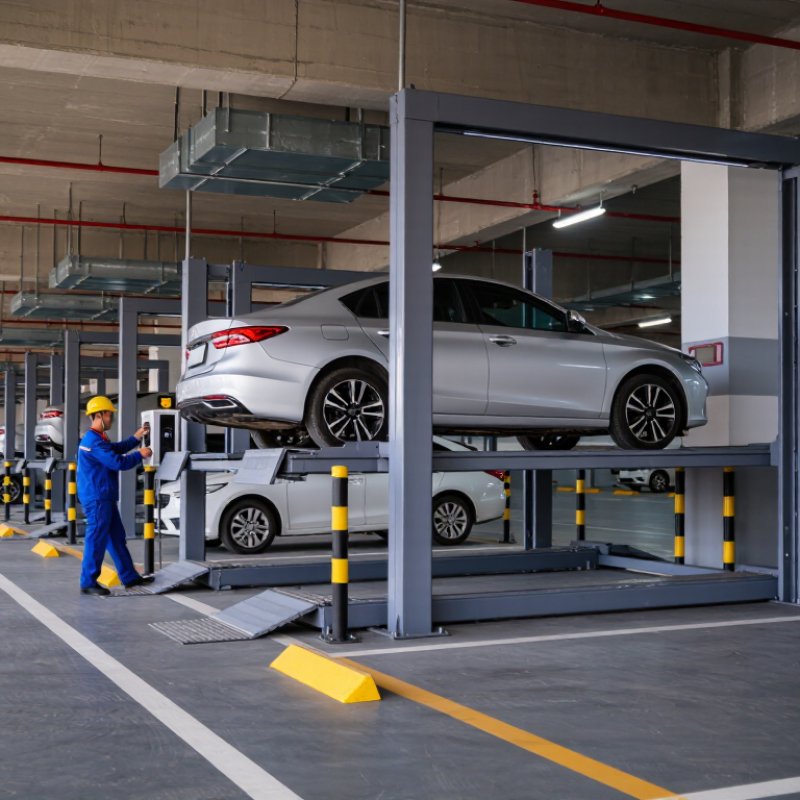
What Is a Car Parking Lift and How Does It Work?

What a Car Parking Lift Is

A car parking lift is a mechanical structure that stores one vehicle above another, using vertical space instead of requiring a second ground-level bay. It usually includes a load-bearing platform, support columns, a lifting mechanism, and safety locks. Some lifts serve two cars; larger systems can store several vehicles across multiple levels. Compact footprint, substantial hardware.

The lift’s rated capacity and platform dimensions determine which vehicles it can hold. The U.S. Environmental Protection Agency’s 2023 Automotive Trends Report puts average new-vehicle weight at about 4,300 pounds for model year 2022. That figure is context, not a design specification: individual vehicles vary, and accessories or cargo add weight. A lift must be selected using its documented load rating, platform width, and clearance—not an average alone.

In a simple two-level lift, a car is driven onto the platform, which rises and locks in place; another vehicle can then use the space below. Designs may use hydraulic or electromechanical lifting systems. The floor, ceiling height, vehicle dimensions, and access route all affect suitability.

A detail that is easy to overlook: a vehicle may meet the weight limit yet still be too tall or wide for the platform. A site assessment helps catch that mismatch.

The Main Components of a Car Parking Lift

A car parking lift is a coordinated machine, not just a platform that rises. Its steel platform supports the vehicle, while columns guide its movement and carry loads into the floor or foundation. A hydraulic cylinder or electric drive supplies lifting force. Mechanical locks hold the platform at working height, so the drive system is not the only support. Small details matter: uneven foundations, worn cables, or misaligned locks can affect safe operation.

The control panel manages movement, while limit switches and obstruction sensors help stop travel when conditions are unsafe. Operators should check the rated capacity on the equipment label, keep the platform clear, and follow the manufacturer’s inspection schedule. The Automotive Lift Institute’s ANSI/ALI ALOIM standard addresses lift inspection and maintenance. That matters. The National Parking Association’s 2020 economic impact study estimated that the U.S. parking industry supported about 570,000 jobs and $131 billion in economic output, underscoring the scale of the systems operators must maintain. A practical weakness is easy to overlook: sensors cannot replace routine checks of locks, hoses, fasteners, and controls.

What Is a Car Parking Lift and How Does It Work?

A car parking lift raises a vehicle on a platform to create an additional parking space below. This chart shows the typical component counts in a four-post, cable-driven lift; configurations vary by model.

The posts support the structure, the runways carry the vehicle, and cables connect the lifting mechanism. A hydraulic power unit supplies lifting force, while the control station operates the lift.

Common Types of Car Parking Lifts

Common Types of Car Parking Lifts

Two-post lifts raise a vehicle by its frame, leaving the wheels accessible for servicing. For parking, they are less common than compact stackers, which place one car above another on a powered platform. A typical two-level stacker suits a narrow residential garage, but the lower car may need to move before the upper space can be used. Simple, but not always convenient. Check ceiling height, vehicle weight, and platform clearance before choosing one.

Four-post lifts support the tires along runways and can store heavier vehicles, including some SUVs, depending on the model’s rating. Puzzle systems use sliding platforms that shift cars horizontally and vertically, creating more spaces in a fixed footprint. Automated tower systems move vehicles mechanically into storage bays, reducing the need for driving aisles. The U.S. Federal Highway Administration’s 2022 National Household Travel Survey reports that about 91% of U.S. households had a vehicle available, a useful reminder that parking demand is widespread. However, that figure does not determine which lift type fits a particular site. A layout may look efficient on paper, yet column positions, turning room, and access frequency can change the practical choice. Have a qualified installer check site conditions and safety features. I would not treat maximum capacity as the only measure.

How a Car Parking Lift Moves and Stores Vehicles

A car parking lift stores one vehicle above another by raising a load-bearing platform. On a common two-post system, hydraulic cylinders pull cables or chains to lift the platform vertically. Other designs use screw drives or guided platforms, but the working sequence is similar. The driver centers the car, applies the parking brake, and exits before activation. Controls raise the deck; mechanical locks engage at set heights and support the parked load. To retrieve the upper car, the operator lowers it, releases the locks, then drives away. Small errors matter.

Capacity and clearance determine whether the lift is safe and useful. The U.S. Environmental Protection Agency’s 2024 Automotive Trends Report puts average new-vehicle weight at about 4,329 pounds for model year 2023. That is a fleet average, not a lift specification. Operators must follow the lift’s rated capacity and account for heavier SUVs, cargo, wheelbase, and roof height. Before raising, check that tires sit within platform guides, doors are shut, and nobody remains underneath. A level floor and regular checks of cables, hoses, locks, and sensors help reduce avoidable risks. Approach angle is easy to overlook. A low bumper or long overhang may hit a post before the tires align.

What Is a Car Parking Lift and How Does It Work? — How a Car Parking Lift Moves and Stores Vehicles

System or Stage How It Works Vehicle Storage Key Components Practical Considerations
Two-level dependent lift A motor-driven hydraulic or mechanical system raises and lowers a platform between ground level and an elevated position. One vehicle is parked on the platform above another vehicle-level space. The lower vehicle generally needs to be moved before the upper vehicle can be accessed. Platform, lifting posts or guide structure, drive system, controls, and mechanical safety locks. Requires a suitable ceiling height, a properly prepared floor, and enough clearance for the vehicles and platform.
Four-post platform lift The platform travels vertically along four supporting posts, commonly using cables, chains, or a hydraulic drive arrangement. Can store a vehicle above another parking space. Some configurations also use the raised platform for vehicle storage without a second vehicle underneath. Four posts, runways or platform, lifting mechanism, safety locks, and operating controls. Platform size and rated load must suit the vehicle. The lift should be installed and used according to its load rating and instructions.
Pit-style lift A platform moves vertically between floor level and a position below or above the surrounding floor, depending on the system design. Vehicles can be arranged on different levels while the platform helps use vertical space. Platform, pit or recessed structure, lifting mechanism, guides, controls, and safety devices. Often requires substantial construction planning, including pit dimensions, drainage, structural support, and access for maintenance.
Automated puzzle system Motorized platforms move horizontally and vertically to reposition vehicles and create an open space for retrieval. Vehicles are stored in a compact grid. A control system coordinates platform movement to bring a selected vehicle to an access point. Parking platforms, motors, rails or guides, sensors, control system, and safety interlocks. Retrieval may involve several platform movements. Access control, system maintenance, and emergency procedures are important.
1. Vehicle positioning The driver aligns the vehicle on the platform or enters the designated system bay, following position markings and operating instructions. Correct positioning helps keep the vehicle within the platform’s specified wheel and dimension limits. Alignment markings, wheel guides or stops where provided, and entry-area controls. Vehicle length, width, height, weight, ground clearance, and tire position must comply with the lift’s limits.
2. Lift activation The operator uses a control station or authorized system interface. The drive raises, lowers, or repositions the platform. The vehicle moves with the platform; it is not driven while the platform is moving. Electric motor, hydraulic power unit or mechanical drive, controller, and operator controls. Controls should be used only as instructed. People must stay clear of moving platforms and restricted areas.
3. Securing at the parking position At the intended position, mechanical locks or other engineered safety devices help secure the platform. Sensors or interlocks may confirm operating conditions. The platform holds the vehicle at its designated storage level until retrieval. Mechanical locks, limit switches, position sensors, and safety interlocks, depending on the system. Safety devices must not be bypassed. Inspection and servicing should follow the manufacturer’s instructions and applicable local requirements.
4. Vehicle retrieval The operator requests the vehicle or uses the prescribed controls. The system moves the platform to an accessible position before the vehicle is driven away. Dependent systems may require another vehicle to be moved first; automated systems may reposition platforms to clear a retrieval path. Controls, drive system, position sensors, locks, and access-area safeguards. Confirm the platform is fully in its permitted loading or unloading position before driving onto or off it.

Note: Lift capacity, platform dimensions, travel height, operating method, and safety features vary by system and installation. Always follow the equipment’s rated limits, operating instructions, and applicable local codes.

Safety Features and Operating Requirements

A car parking lift raises one vehicle on a platform, creating another parking space below or above. Its safety depends on both hardware and careful operation. A well-designed system may include mechanical locking devices, overload protection, travel-limit switches, and an emergency stop.

Locks should engage before anyone treats the platform as secure. Keep the rated load visible, and position the vehicle within the marked wheel guides. Small details matter.

Operators should be trained on the specific lift, check the platform and controls before use, and keep people clear during movement. Never exceed the stated capacity or rely on hydraulics alone to hold a raised platform.

The ANSI/ALI ALCTV safety standard covers lift design, testing, and validation; owners should also follow the manufacturer’s operating and inspection instructions.

The U.S. Bureau of Labor Statistics counted 5,283 fatal work injuries across U.S. industries in 2023. That figure is not lift-specific, as documented in its Census of Fatal Occupational Injuries, 2023. Still, it underscores why routine checks should be real checks, not a box-ticking ritual. I would not treat a green indicator as proof that the platform is clear or correctly loaded.

Choose a global leader for your hydraulics solutions

How can we help you?

Call to 0034 943884600 Contact us
Call us Contact us

We use cookies to ensure that we give you the best experience on our website. If you continue without changing your settings, we'll assume that you agree to receive cookies on the HINE website. For more information read our cookie policy page, click the link for more information.plugin cookies

ACEPTAR
Aviso de cookies