China Top Hydraulic Parts Suppliers for Global Buyers?
Choosing China-based hydraulic parts suppliers requires more than comparing catalog prices. Buyers need to assess material quality, machining accuracy, pressure ratings, testing records, and after-sales support. A valve that looks identical in a product photo may perform differently under heat, vibration, or continuous duty. Small details matter.
Fluid-power engineer Herbert E. Merritt is widely known for his work on hydraulic control systems. A practical buyer’s principle, consistent with that engineering focus, is: “Judge a component by its performance in the system, not by its price or appearance alone.” This is a paraphrase, not a verified direct quotation. That distinction matters when technical advice guides purchasing decisions.
This guide examines how global buyers can evaluate Chinese suppliers of pumps, valves, cylinders, seals, and related components. It considers factory capabilities, product documentation, quality-control practices, communication, lead times, and sample testing. Ask for clear specifications. Check thread types, operating pressures, materials, and compatibility with the equipment already in service. A polished brochure is useful, but it cannot replace test data or a careful review of real requirements. No supplier is ideal for every application, and even a well-qualified factory can make mistakes. Buyers should verify claims, document agreed specifications, and allow time for inspection. The aim is not to declare one supplier “best,” but to make selection more informed, practical, and dependable.
Map China’s Hydraulic Parts Supply Chain: Pumps, Valves, Motors, and Cylinders
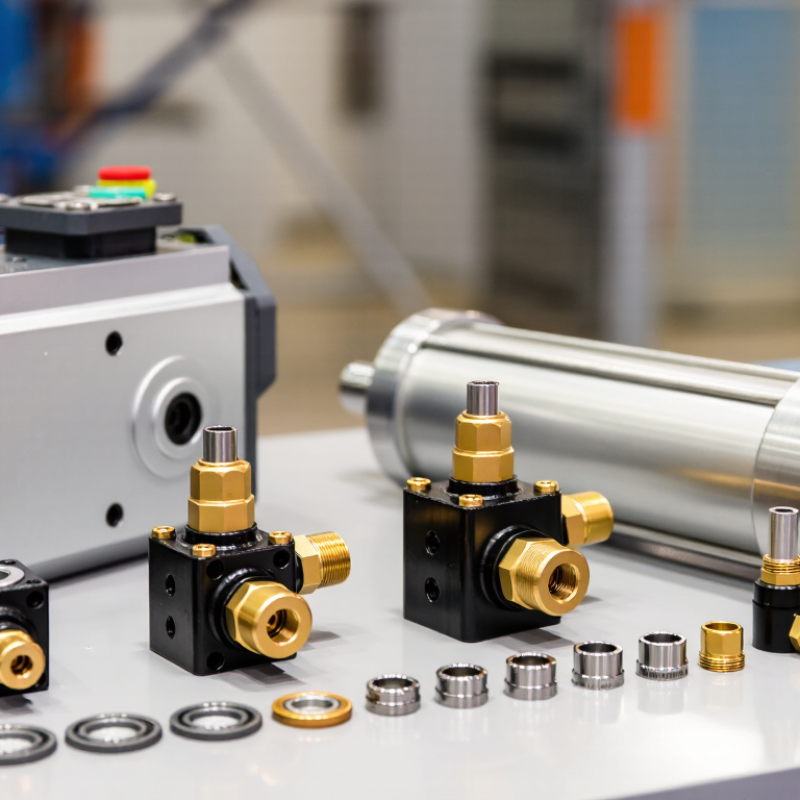
China’s hydraulic parts supply chain is best understood by component, not by a single factory label. Pumps convert mechanical power into fluid flow; common designs include gear, vane, and piston types. Valves direct flow and regulate pressure, while hydraulic motors turn fluid power back into rotation. Cylinders deliver linear force, often using a honed steel barrel, a piston, and carefully matched seals.
Grand View Research estimated the global hydraulic equipment market at
USD 45.8 billion in 2023,
with a projected
5.3% compound annual growth rate from 2024 to 2030.
This broad market estimate covers more than Chinese-made parts, so it is context, not a China export figure. Still, it signals demand across mobile machinery, manufacturing, and construction.
Small details matter. For buyers mapping Chinese suppliers, ask whether machining, heat treatment, sealing, and final testing happen in-house or through subcontractors.
Compare parts by operating pressure, flow rate, materials, tolerances, and test documentation—not price alone. For example, a pump’s rated flow may look suitable on paper, yet fluid temperature or contamination can affect performance in service. Request inspection records and sample test results. The map is useful, but imperfect: supplier categories overlap, and catalog descriptions do not always reveal who made each component. Treat the supply-chain view as a starting point, then verify the actual production and quality-control process.
Compare Suppliers by Rated Pressure, Flow Rate, and Pump Displacement
Global buyers should compare hydraulic suppliers using rated pressure, delivered flow, and pump displacement—not pressure alone. ISO 4409:2019 sets test methods for measuring positive-displacement pump performance, including flow, speed, and torque. Ask for test results at the operating pressure you expect, rather than relying only on a catalogue’s maximum rating. A high pressure figure means little if flow falls sharply under load.
Displacement shows how much fluid a pump moves per revolution. For example, a 45 cm³/rev pump running at 1,500 rpm has a theoretical flow of 67.5 L/min.
At 90% volumetric efficiency, delivered flow is about 60.8 L/min. Check whether supplier figures are theoretical or measured, and confirm the test speed. Small differences matter.
Compare continuous and peak pressure ratings separately. Then check inlet conditions, oil viscosity, temperature limits, and case-drain requirements against your system. These details are easy to overlook. Even a neat comparison table has a blind spot: test conditions may differ between suppliers. Requesting the same pressure, speed, and fluid conditions makes the comparison more useful, though it still cannot predict every installation issue.
Check Fluid Cleanliness Using ISO 4406’s ≥4, ≥6, and ≥14 μm Counts
China Top Hydraulic Parts Suppliers for Global Buyers?
Hydraulic oil may look clear while carrying particles that wear pumps, valves, and seals. Looks can deceive. ISO 4406 reports three cleanliness code numbers, linked to particle counts at ≥4, ≥6, and ≥14 μm(c) per millilitre. The counts are cumulative: particles counted at ≥14 μm also fall within the larger-size thresholds. Higher code numbers indicate more particles.
For buyers comparing hydraulic parts suppliers, request a recent fluid cleanliness report and check its sampling date and method. The ≥4 μm count can reveal fine contamination; the ≥6 and ≥14 μm counts help show larger particles that may threaten tight clearances. Match results to the equipment maker’s specified cleanliness target, not a generic “clean” label. Small details matter. A result from one sample is only a snapshot, and handling can affect it. That part is easy to overlook.
Tips: Use a clean sampling bottle and draw oil from a live, representative sampling point. Record the machine condition and sample location. If readings seem inconsistent, repeat the test before drawing firm conclusions.
China Top Hydraulic Parts Suppliers for Global Buyers? - Check Fluid Cleanliness Using ISO 4406’s ≥4, ≥6, and ≥14 μm Counts
Use these ISO 4406 particle-count bands as a reference when discussing hydraulic-fluid cleanliness with suppliers. Each count is cumulative: particles at the stated size channel and larger, per millilitre of fluid.
| Example ISO 4406 code |
≥4 μm(c), particles/mL |
≥6 μm(c), particles/mL |
≥14 μm(c), particles/mL |
General cleanliness level |
| 20/18/15 |
5,000–10,000 |
1,300–2,500 |
160–320 |
Relatively high particle count |
| 19/17/14 |
2,500–5,000 |
640–1,300 |
80–160 |
Moderate particle count |
| 18/16/13 |
1,300–2,500 |
320–640 |
40–80 |
Cleaner fluid reference |
| 17/15/12 |
640–1,300 |
160–320 |
20–40 |
Low particle count reference |
| 16/14/11 |
320–640 |
80–160 |
10–20 |
Very low particle count reference |
Note: ISO 4406 codes are reported as three numbers for the cumulative particle counts at the 4, 6, and 14 μm(c) channels. The count ranges shown are particles per millilitre. These example profiles are reference data, not supplier test results or universal acceptance limits; confirm the required cleanliness level, sampling method, and particle-counter calibration with the component manufacturer and system requirements.
Assess System Safety Against ISO 4413 Hydraulic-System Requirements
China’s hydraulic suppliers should be assessed against ISO 4413, not pressure ratings alone. The standard sets safety requirements for hydraulic systems and components, including pressure control, leakage risks, and unexpected movement. Ask for circuit diagrams, operating limits, and evidence that relief devices match the system’s maximum pressure. Check the details. A test bench may show stable pressure, yet miss a hose that rubs against a sharp frame edge during machine movement.
Bureau of Labor Statistics data reported 2.8 recordable injury and illness cases per 100 full-time workers in U.S. manufacturing in 2023. This figure is not specific to hydraulic equipment, but it shows why practical safeguards matter. When reviewing suppliers, inspect how they address stored pressure, hose failure, maintenance isolation, and safe discharge before service. Request test records for pressure and leakage, and verify materials against the actual fluid and temperature range. A neat certificate is useful, but it cannot replace a system-level review. I have seen purchasing checks focus too heavily on component dimensions; that can leave installation hazards overlooked. ISO 4413 alignment should be confirmed for the complete assembly and its intended use.
Hydraulic-System Safety Checks for Global Buyers
A practical checklist view inspired by ISO 4413:2010, the safety standard for hydraulic fluid power systems.
Bars count example verification questions in each topic—not ISO clause counts, supplier ratings, or audit results. Confirm applicable requirements against the standard and the specific system design.
Match Supplier Export, Testing, and Service Capabilities to Buyer Needs
A supplier’s export record matters as much as its catalogue. Check whether quotations state pressure ratings, materials, delivery dates, and packing details. Ask for sample export documents and a clear process for reporting transit damage. Grand View Research estimated the global hydraulic equipment market at US$40.8 billion in 2023, with projected growth through 2030. That figure signals a large, varied market; it does not prove any supplier’s reliability.
Testing claims need evidence. Request dated reports showing pressure, leakage, flow, and cleanliness checks for the specific part or production batch. Where relevant, ask whether pressure-impulse testing follows ISO 10771-1. Compare the test conditions with your operating pressure and duty cycle, not just the pass mark. Small details count. A readable serial number and traceable test record can save hours during commissioning. Service capability deserves equal scrutiny: confirm response times, troubleshooting access, spare-part availability, and support across your time zone. A polished certificate is useful, but it cannot show how quickly a real fault will be handled. I would also question unusually short lead times; sometimes the promised schedule deserves a second look.