

How to Choose the Best Electric Block Machine in 2026?

Choosing the best Electric Block Machine in 2026 starts with the products you plan to make, not the largest capacity figure on a brochure. UN DESA’s World Urbanization Prospects: The 2018 Revision projects that 68% of the world’s population will live in urban areas by 2050. That long-term shift supports demand for construction, but it does not guarantee orders for any individual producer. Local building practices, transport costs, and seasonal demand still matter. There is no perfect machine.

Environmental performance also deserves attention. The Global Cement and Concrete Association reports that cement production accounts for roughly 7% of global CO₂ emissions. A block machine cannot fix the footprint of a cement mix, but efficient motors, sensible production planning, and reduced rejected blocks can help limit avoidable waste. Numbers need context. Reported output often assumes ideal materials, skilled operators, and uninterrupted production. Actual results can differ.

Compare machines using the same practical checklist: verified blocks per hour, compatible mold sizes, vibration and compaction quality, power use, changeover time, and access to spare parts. Ask suppliers for test results using your intended mix, then inspect sample blocks for dimensions, edges, and consistency. A low purchase price can look attractive until a worn mold or delayed component stops production. The right choice balances output with service support, operating costs, and the products your customers actually need. Some estimates will remain uncertain; record your assumptions before committing.
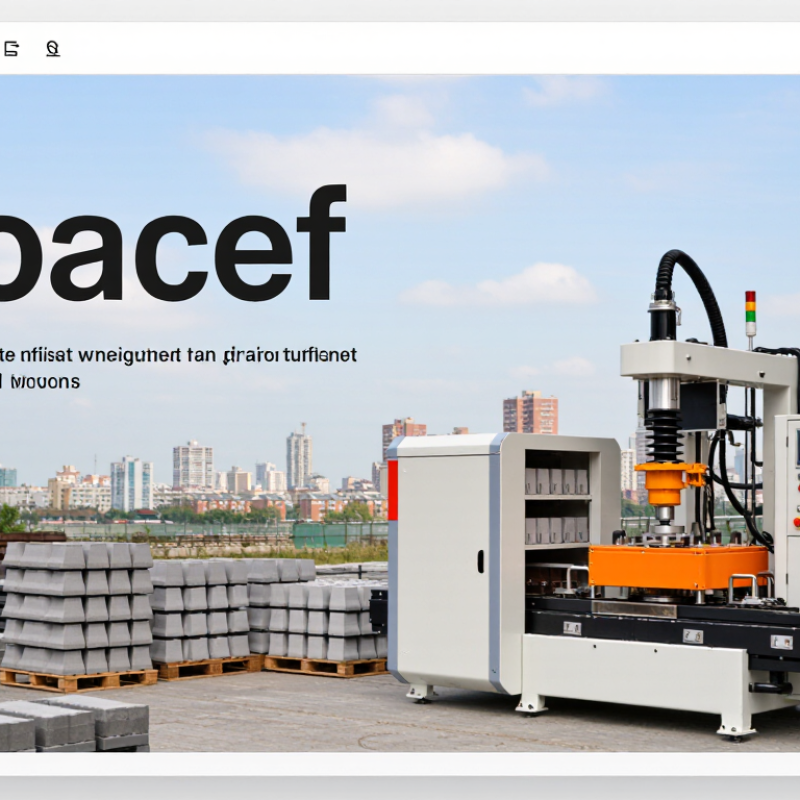
How to Choose the Best Electric Block Machine in 2026?

Map demand to rated output: compare blocks per hour, mold cavities, and shift yield

How to Choose the Best Electric Block Machine in 2026?

Match rated output to actual orders, not an optimistic brochure figure. The U.S. Census Bureau reported construction spending rose 7.0% in 2023, while Dodge Construction Network’s 2024 Outlook forecast a 7% rise in construction starts. Both figures signal activity, not guaranteed block sales. Check local project schedules and block sizes before choosing capacity.

Convert daily demand into a shift target. For example, an eight-cavity mold running a 12-second cycle has a theoretical output of 2,400 blocks per hour. At 65% effective production, that becomes about 1,560 saleable blocks per hour. The 65% is an illustrative planning assumption, not an industry standard. Allow for feeding, curing logistics, mold changes, rejected units, and operator breaks. Small stoppages add up.

Compare machines using the same mold, block type, and shift length. Ask suppliers for measured output records, including changeovers and rejects, then run a trial with your aggregate mix. Real shifts vary. A high cavity count may raise output, but only if the mixer, pallet flow, and curing area keep pace. The spreadsheet can lie. I would leave a little capacity uncommitted; demand forecasts and production days rarely behave perfectly.

Set strength criteria with ASTM C90: 2,000 psi average net-area compressive strength

How to Choose the Best Electric Block Machine in 2026?

Set strength criteria with ASTM C90: 2,000 psi average net-area compressive strength

When comparing electric block machines, define the strength target before comparing production speed. ASTM C90 requires loadbearing concrete masonry units to achieve an average net-area compressive strength of at least 2,000 psi. Individual tested units must meet a 1,800 psi minimum. The net-area figure matters: it measures strength against the solid material, not the block’s full outer dimensions.

ASTM C140/C140M sets out procedures for sampling and testing units. Ask for recent test results from blocks made with the proposed mix, mold, and curing process. A showroom sample is not enough.

A capable machine should produce consistent blocks across a full shift. Check dimensions, face-shell thickness, chipped edges, and density alongside laboratory results. Those details can reveal uneven compaction early.

Compare test certificates with the plant’s normal production and curing conditions, rather than relying on motor power or vibration claims. ASTM’s standards provide measurable criteria, but they do not remove the need for production trials. And a faster line can multiply rejects. Leave time for calibration and retesting; this part of machine selection is easy to underestimate.

Check dimensional control against ASTM C90: ±1/8 in. from specified dimensions

A block machine should produce more than a convincing sample. It should hold specified dimensions through normal production. ASTM C90 uses a tolerance of ±1/8 in. from specified dimensions. Check the standard’s current edition and the project specification before setting acceptance criteria. Small differences matter when units are laid in long, straight runs.

Ask for trial blocks made with the mix and aggregate you expect to use. Measure length, width, and height on several cured units, not just one fresh block. Use a calibrated rule or measuring device, and record the results. Look for patterns: repeated height variation may point to mold wear, uneven filling, or inconsistent compaction. A machine setting can help. It cannot fix every process problem.

Check how easily operators can adjust the mold, vibration, and feed system, then repeat the trial. Keep the measurements. Even a simple spreadsheet can reveal drift before a full pallet is affected. I would also inspect the corners and faces; dimensions may pass while edges look rough. That judgment is a little subjective, and I have seen teams disagree. Still, it is useful when comparing machines under the same conditions.

How to Choose the Best Electric Block Machine in 2026? — Check Dimensional Control Against ASTM C90: ±1/8 in. from Specified Dimensions

Use this checklist to assess whether a machine can consistently produce units that meet the project’s dimensional requirements. ASTM C90 dimensional tolerances apply to finished concrete masonry units, not to the machine itself.

Evaluation item Reference or target Example measurement or question How to assess the machine
Finished-unit dimensional control — illustrative example
Length Specified: 15.625 in. (15 5/8 in.)
Permitted range: 15.500–15.750 in.
Illustrative reading: 15.690 in.
Deviation: +0.065 in.
Within ±0.125 in. tolerance
Width Specified: 7.625 in. (7 5/8 in.)
Permitted range: 7.500–7.750 in.
Illustrative reading: 7.600 in.
Deviation: −0.025 in.
Within ±0.125 in. tolerance
Height Specified: 7.625 in. (7 5/8 in.)
Permitted range: 7.500–7.750 in.
Illustrative reading: 7.700 in.
Deviation: +0.075 in.
Within ±0.125 in. tolerance
Measurement plan Measure finished units against the specified dimensions and applicable project requirements. Ask how the supplier recommends sampling units from a production run and recording results. Confirm the plan includes suitable measuring tools, repeatable measurement locations, and retained records.
Machine-selection checks
Mold and product changeover Mold configuration must suit the required unit type, dimensions, and production range. Can the mold be changed and aligned using documented setup instructions? Request a demonstration of setup and a dimensional check after changeover.
Vibration and compaction settings Settings should be adjustable and repeatable for the selected mix and product. Can operators record and restore the settings used for an approved production run? Look for clear controls and a repeatable operating procedure; verify results with finished-unit measurements.
Electrical requirements Power supply must match the installation site and the machine’s electrical documentation. Confirm required voltage, phase, frequency, and connected load with the supplier. Have a qualified electrician verify site compatibility before purchase and installation.
Production capacity Compare demonstrated output for the specific unit and operating conditions—not a headline maximum alone. Ask what cycle time and daily output are achievable with the chosen mold, staffing, and curing workflow. Request a product-specific production trial and clarify what is included in the stated output.
Quality records and support Consistent production requires documented setup, inspection, maintenance, and operator training. Ask for sample inspection forms, maintenance instructions, and training details. Choose a supplier that can explain how to troubleshoot dimensional variation and maintain production records.

Note: The example readings are illustrative only and are not test results for a particular machine or product. The example uses common nominal 8 × 8 × 16 in. CMU dimensions, which correspond to specified dimensions of 7 5/8 × 7 5/8 × 15 5/8 in. Always verify the current ASTM C90 edition, the unit type, and the project specifications before determining acceptance.

Compare machine systems by vibration, hydraulic pressure, cycle time, and mold flexibility

How to Choose the Best Electric Block Machine in 2026?

Compare vibration, hydraulic pressure, cycle time, and mold flexibility on the same mix. Vibration should compact material evenly, not merely shake the frame. Watch a fresh block emerge: loose corners, visible voids, or uneven height can signal poor compaction. Hydraulic pressure affects feeding and pressing, but higher pressure alone does not guarantee stronger units. Check pressure stability across repeated cycles and record the results. Small details matter.

Cycle time is useful only when product quality stays consistent. Time several runs with the intended block size, mix, and operator; a showroom cycle may not reflect daily production. ASTM C90-23 sets a minimum average net-area compressive strength of 2,000 psi for loadbearing concrete masonry units, with no individual unit below 1,800 psi. Verify finished units using ASTM C140/C140M test methods, rather than relying on machine settings. Mold flexibility also matters: confirm changeover time, available cavity layouts, and whether the machine can produce your planned shapes without extensive adjustment. One caveat: comparing pressure figures across systems can mislead, because mold design and mix moisture also affect compaction. Get trial data for your own products before choosing.

How to Choose the Best Electric Block Machine in 2026?

Compare vibration, hydraulic pressure, cycle time, and mold flexibility. The ranges below are indicative planning benchmarks, not specifications for every machine; confirm operating values and mold compatibility with the equipment supplier.

How to use this comparison: Check that the vibration system suits your mix and product, hydraulic pressure meets the machine’s stated requirements, and cycle time matches your required output. For mold flexibility, verify which product formats the machine supports and how quickly molds can be changed. Actual performance depends on machine design, block type, materials, and operating conditions.

Calculate ownership cost from power, labor, curing capacity, uptime, and spare parts

In 2026, compare electric block machines by the cost of saleable blocks, not the purchase price alone. During a timed trial, record the electricity meter before and after production. Divide kilowatt-hours by accepted blocks, then estimate the cost per thousand using your local power rate. Include start-up periods, cleaning, and rejected blocks. A fast cycle means little if many units crack or need rework.

Labor and curing capacity shape the real output. Note how many workers are needed to feed, operate, clear, and stack the machine. Then check whether racks, floor space, and curing time can handle its daily output. If blocks wait for space, the machine may sit idle despite a high rated capacity. Small details matter. A practical test on your own mix is more useful than relying only on a supplier’s best-case figures.

Estimate uptime from maintenance needs, service response, and access to common wear parts. Ask which parts should be kept on site, how long replacements usually take, and what routine checks require downtime. Add power, labor, curing, maintenance, and spare-part costs across a realistic production period. Divide that total by accepted blocks. The result is still an estimate; shift patterns, weather, and operator experience can change it. That uncertainty is worth allowing for.

Choose a global leader for your hydraulics solutions

How can we help you?

Call to 0034 943884600 Contact us
Call us Contact us

We use cookies to ensure that we give you the best experience on our website. If you continue without changing your settings, we'll assume that you agree to receive cookies on the HINE website. For more information read our cookie policy page, click the link for more information.plugin cookies

ACEPTAR
Aviso de cookies