

Choosing the best Smart Air Pressure Gauge is not simply a matter of selecting the largest display or lowest price. Accuracy, sensor stability, response time, battery life, and ease of use matter more beside a cold tire. The U.S. Department of Energy reports that properly inflated tires can improve fuel economy by about 0.6% on average, with greater savings possible in some vehicles. Small pressure errors still create real costs.
The market is moving toward connected measurement. Fortune Business Insights identifies rising demand for tire pressure monitoring systems, driven by vehicle safety, digital maintenance, and regulatory awareness. However, a Smart Air Pressure Gauge is not automatically precise because it uses Bluetooth or an application. Convenience can hide calibration problems. That deserves attention.
Former NHTSA Administrator Mark Rosekind stated, “Tire pressure is the easiest thing to check and the most important thing to check.” His point remains practical. A good gauge should show stable readings, support the pressure units you use, and survive dust, drops, and temperature changes. It should also explain its limits clearly.
This guide compares those details through an experience-based lens. We will examine accuracy claims, sensor calibration, valve compatibility, app reliability, and after-sales support. Independent testing and manufacturer specifications will guide the comparison. Still, no single report answers every buying question. Real workshop conditions can be messier.
A cheaper gauge may perform well. A premium model may disappoint.
The best Smart Air Pressure Gauge is the one that delivers trustworthy readings when pressure matters most, not merely impressive features on a product page.
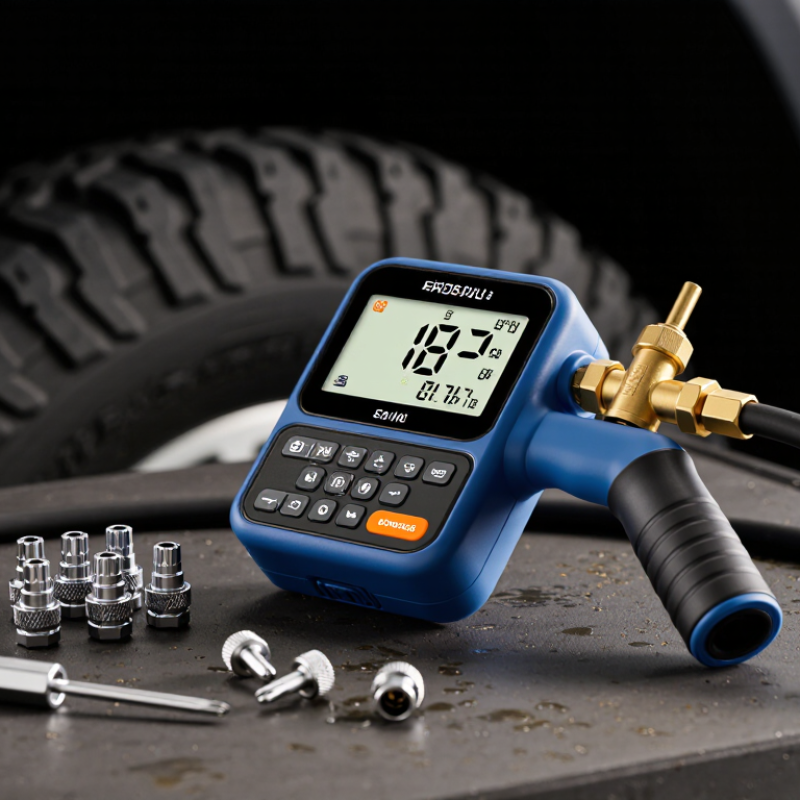
Choosing the best smart air pressure gauge starts with the job, not the display. For vehicle tires, select a model with a low-pressure range, fine resolution, and a dependable valve connection. The U.S. Department of Energy reports that each 1 psi of tire underinflation may reduce fuel economy by about 0.2%. A gauge accurate to 0.1 or 0.5 psi can therefore support safer, more consistent checks. I prefer readings taken on cold tires, because heat changes pressure quickly.
HVAC Work HVAC work demands a different approach. Refrigerant pressure must match refrigerant temperature, system conditions, and manufacturer specifications. The ASHRAE Handbook explains this pressure-temperature relationship clearly. Choose a gauge with suitable high- and low-pressure ranges, temperature sensing, and stable readings near vacuum when required. A wide range looks impressive, but it may reduce resolution where technicians actually work. That range matters.
Pneumatic Systems Pneumatic systems usually need higher pressure capacity and stronger fittings. The U.S. Department of Energy’s Compressed Air Sourcebook notes that many industrial systems operate around 90 to 120 psi, although applications vary widely. Select a gauge rated above the system’s maximum working pressure, with a margin for pulsation. Digital logging can reveal pressure drops across filters, hoses, or regulators. Still, smart features do not correct a poor connection. I have trusted a clean screen too quickly before. Verify the gauge against a calibrated reference, especially when maintenance decisions depend on small pressure changes.
Choosing a smart air pressure gauge requires more than checking its screen or wireless features. Accuracy claims need careful comparison. Under ASME B40.100, accuracy classes describe performance requirements for pressure instruments. However, a stated class and a ±1% full-scale rating may not mean exactly the same thing.
A ±1% full-scale gauge rated from 0 to 100 psi can deviate by up to 1 psi anywhere across its range. At 80 psi, that is 1.25% of the actual reading. At 10 psi, it becomes 10%, which may affect leak testing or low-pressure adjustment. This detail is often missed. Choose a narrower range when practical, rather than selecting a gauge far above the working pressure.
Check the datasheet for reference conditions, temperature limits, display resolution, and calibration procedures. ASME B40.100 terminology should be matched with the specific edition and manufacturer documentation. Do not assume every accuracy class automatically equals ±1% full scale. Ask whether the rating includes sensor drift, temperature effects, and digital conversion errors.
In field testing, I would compare the gauge against a traceable reference at several pressure points. Check it cold and after continuous operation. Small errors appear there. A robust enclosure also matters around compressors, moisture, and vibration. Wireless alerts are useful, but they cannot repair poor calibration. One practical weakness remains: specifications may look precise while real conditions are not. That deserves a closer review.
For 0–60 psi tire applications, choose a gauge that matches real driving conditions, not marketing claims. Select psi for North American vehicles, or bar and kPa when your workshop follows international specifications. A 0.1 psi resolution helps when setting passenger-car tires near 30–40 psi. Higher resolution is useful, but it does not guarantee higher accuracy. Check the stated accuracy, ideally around ±1% of full scale or better.
Sensor design also matters. A sealed pressure sensor resists dust, moisture, and repeated valve contact. Temperature compensation is important because tire pressure changes as air heats during driving. The U.S. Department of Energy reports that correctly inflated tires can improve fuel economy by up to 3.3% (FuelEconomy.gov). NHTSA’s tire-pressure research also linked tire-pressure monitoring with fewer seriously underinflated tires. These figures support careful measurement, but real results vary with load, temperature, and tire condition.
Tips: Compare the gauge with a calibrated reference every few months. Test it at 0, 30, and 60 psi. Watch the display in low light. A 0–60 psi range suits most passenger tires, but it may be too narrow for trailers or commercial vehicles. Do not confuse fine display increments with trustworthy readings. That mistake is common. A sensor can show 0.01 psi while drifting several tenths. Check the valve connector, battery behavior, and automatic shutoff before purchase. A slightly slower reading may be more dependable than an impressive display.
A smart air pressure gauge should be judged beyond its digital display. Calibration is the first serious checkpoint. Ask whether the instrument was tested against a traceable reference and whether the certificate identifies pressure points, uncertainty, and test temperature. Calibration from an ISO/IEC 17025-accredited laboratory offers stronger evidence than a simple factory claim. In field work, I record readings at low, middle, and high pressure. Small errors often appear near the limits. That detail is easy to miss.
IP ratings also deserve careful reading. Under IEC 60529, IP65 generally indicates protection from dust and water jets, while IP67 includes temporary immersion protection. These ratings do not prove resistance to oil, vibration, impact, or repeated pressure shocks. Check the complete operating environment. A gauge mounted near a compressor may face condensation, metal dust, and sudden pulses. A sealed case helps, but it cannot correct poor installation.
Temperature performance can change the result more than expected. Compare the stated accuracy across the full operating range, not only at 20°C. Look for temperature compensation, thermal drift data, and a response standard that matches your application. For demanding measurements, request test evidence linked to recognized calibration procedures. I once trusted a wide temperature claim without checking warm-up time. The readings stabilized slowly. That mistake remains worth remembering. Short specifications can hide long maintenance problems.
A smart air pressure gauge should connect reliably before you trust its readings. Test Bluetooth pairing beside the vehicle, then repeat it near the tire. A weak connection can interrupt measurements or delay pressure updates. The app should display pressure clearly and identify the correct tire. Avoid systems that require excessive permissions or constant internet access. Simple operation is safer beside traffic.
Battery life matters more than impressive features. Choose a gauge with a replaceable or rechargeable battery and a visible low-power warning. In practical use, cold mornings can reduce battery performance. Keep a charging cable or spare battery in the glove compartment. I once assumed a nearly full battery would last through a trip. It did not. That mistake made routine checks impossible.
Check how the product relates to NHTSA TPMS safety requirements in the United States. Federal rules require vehicles to warn drivers when tire pressure falls significantly below the recommended placard level, commonly around 25 percent underinflation under specified conditions. A smart gauge does not replace the vehicle’s TPMS. It provides a manual verification tool. Compare its readings with the door-jamb placard, not the tire’s maximum pressure. Look for documented accuracy testing, clear calibration guidance, and pressure units suited to your vehicle. Some instructions remain vague, which deserves caution. A gauge can be connected, powerful, and still poorly explained.
How can we help you?
Call to 0034 943884600 Contact usWe use cookies to ensure that we give you the best experience on our website. If you continue without changing your settings, we'll assume that you agree to receive cookies on the HINE website. For more information read our cookie policy page, click the link for more information.plugin cookies
ACEPTAR