

2026 Best Hydraulic Hose Fittings Which Should You Buy?
Choosing the best hydraulic hose fittings for 2026 requires more than comparing prices or polished product photographs. A fitting must match hose construction, pressure ratings, temperature limits, fluid compatibility, and installation practice. Small errors can cause leaks, abrasion, or sudden hose separation.
Industry data shows why this decision matters. Grand View Research estimated the global hydraulic hose market at approximately USD 2.5 billion in 2022. Its report also projected steady growth through 2030, supported by construction, agriculture, mining, and industrial equipment demand. MarketsandMarkets has similarly identified mobile hydraulics and heavy machinery as important growth areas. These figures describe hoses and related systems, not fittings alone. Still, they reveal a growing need for dependable connections.
Standards matter. SAE J517 defines hydraulic hose performance requirements, while ISO 18752 addresses hose classifications and pressure performance. Experienced technicians also inspect thread form, sealing method, bend radius, and visible damage before installation. A fitting that fits the thread may still be unsafe.
This guide compares stainless steel, carbon steel, reusable, crimped, metric, BSP, JIC, and ORFS options. It considers working pressure, corrosion exposure, assembly tools, replacement availability, and total ownership cost. Field conditions are rarely perfect. Dust enters, hoses twist, and specifications are sometimes incomplete. That weakness deserves attention. No single fitting suits every machine, and manufacturer data should always outrank a generic buying chart. The right choice depends on verified measurements and realistic operating conditions.
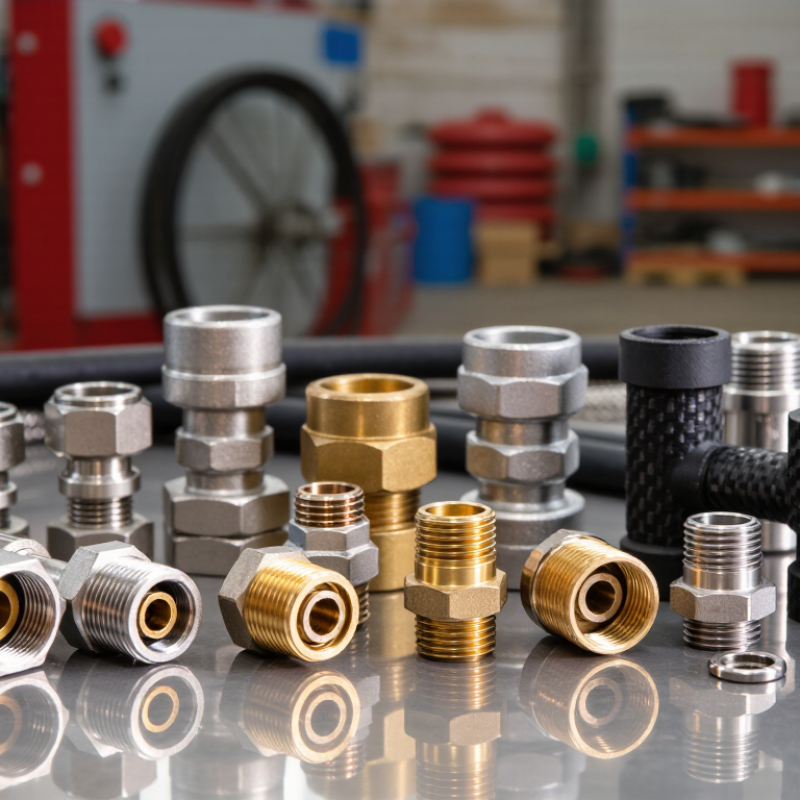
What Are Hydraulic Hose Fittings and How Do They Work?
Hydraulic Hose Fittings: What They Are and How They Work
Hydraulic hose fittings connect flexible hoses to pumps, valves, cylinders, and other hydraulic components. They create a sealed path for pressurized fluid. Without a reliable fitting, even a strong hose can fail.
A fitting usually has a body, connection thread, sealing surface, and hose attachment. Crimped fittings grip the hose permanently around its outer layers. Reusable fittings use mechanical parts that hold the hose without factory crimping. Some fittings swivel, allowing easier installation and reducing hose twisting.
The connection must match the hose size, pressure rating, thread type, and fluid requirements. A small mismatch can cause leakage, vibration, or sudden separation. Thread appearance alone is not enough. Two fittings may look similar but use different sealing methods. I have seen clean installations fail because a seal was tightened too aggressively. More force does not always create a better seal.
Tips: Measure carefully.
Check the hose outside diameter and fitting specifications before assembly. Inspect threads for damage, then clean every connection. Keep the bend radius gentle near the fitting. After installation, run the system at low pressure and inspect for seepage. Never touch a suspected leak with your hand. High-pressure fluid can penetrate skin, even when the leak looks tiny. If a fitting feels uncertain, replace it rather than trusting appearance.
2026 Best Hydraulic Hose Fittings Which Should You Buy? - What Are Hydraulic Hose Fittings and How Do They Work?
Hydraulic hose fittings are mechanical connectors that join a hydraulic hose to another hose, a tube, a valve, a pump, a cylinder, or a machine port. They maintain a sealed fluid path while transferring hydraulic oil under pressure. The best choice depends on the connection standard, hose size, working pressure, temperature, fluid compatibility, movement, and installation environment.
| Fitting Type | Connection or Sealing Method | Common Thread or Interface | Typical Application | Main Advantages | Important Limitations | Selection Guidance | Recommended Choice |
|---|---|---|---|---|---|---|---|
| JIC 37° Flare | Metal-to-metal seal between a 37-degree flared fitting and matching cone | Usually straight or parallel-style threads with a 37-degree flare; thread size must match the mating port | Mobile hydraulics, machinery, equipment exposed to vibration, and serviceable hose assemblies | Reliable when correctly assembled; reusable in many service applications; good resistance to vibration and thermal cycling | Flare surfaces can be damaged by over-tightening, contamination, or misalignment | Inspect the flare before assembly and tighten according to the applicable fitting specification rather than relying only on feel | Best general-purpose option |
| ORFS Face Seal | Elastomeric O-ring seals the flat face of the fitting | O-ring face seal connection; available in multiple standardized thread systems | High-pressure systems, industrial machinery, construction equipment, and applications where leakage control is critical | Very strong leakage resistance; suitable for vibration; the seal is isolated from the thread | O-rings require correct material, lubrication, groove condition, and temperature compatibility | Choose when minimizing external leakage is more important than minimizing fitting size or cost | Best for leak prevention |
| NPTF Tapered Pipe Thread | Metal thread interference; sealing normally depends on thread engagement and approved thread sealant where permitted | National Pipe Tapered Fuel thread; not interchangeable with BSP threads | Older or region-specific hydraulic equipment, adapters, gauges, and low-to-medium complexity connections | Widely recognized in North America; simple and readily available in many sizes | Repeated assembly can damage threads; excessive torque may crack ports; thread sealant must not enter the hydraulic circuit | Use only when the equipment port is specifically designed for the same NPT or NPTF standard | Best for matching existing NPT ports |
| BSPP with Bonded Seal | Parallel thread positions the fitting while a bonded washer or sealing ring seals the port face | British Standard Pipe Parallel; commonly identified as G thread | Industrial hydraulic systems, European equipment, manifolds, pumps, and valves | Good sealing performance; predictable installation; does not rely on thread interference | Must be paired with the correct sealing washer and port design; BSPP is not interchangeable with NPT | Choose when the equipment documentation specifies a parallel British pipe thread and face seal | Best for BSPP industrial ports |
| BSPT Tapered Pipe Thread | Tapered thread interference with a suitable hydraulic thread sealant when allowed by the system design | British Standard Pipe Tapered; commonly identified as R thread | Selected industrial and mobile equipment using British pipe-thread standards | Compact connection; common in systems designed around BSPT standards | Can be confused with BSPP; tapered threads can stress ports if over-tightened; sealant control is important | Confirm whether the port is tapered or parallel before purchasing the fitting | Best only for matching BSPT ports |
| Metric DIN 24° Cone | 24-degree cone seal, commonly used with a cutting ring or an O-ring depending on the fitting design | Metric thread with a 24-degree tube or cone interface | European mobile hydraulics, tube assemblies, manifolds, and high-pressure machinery | Compact metric design; strong mechanical connection; suitable for rigid tube and hose transitions | Different 24-degree designs are not automatically interchangeable; tube preparation and assembly quality matter | Match the cone angle, thread size, tube outside diameter, and sealing arrangement exactly | Best for metric hydraulic equipment |
| SAE Code 61 Flange | Split-flange connection with an elastomeric O-ring compressed against a flat flange face | Four-bolt flange pattern; commonly classified as a 3000 psi or 6000 psi series by design, size, and manufacturer specification | Large hydraulic lines, pumps, motors, high-flow circuits, and connections subject to high vibration | Handles large flow passages; strong resistance to vibration; avoids high torque on threaded ports | Requires adequate installation space and correct bolt tightening; pressure rating is size- and component-specific | Use when hose size, flow rate, vibration, or port strength makes threaded fittings less suitable | Best for large high-flow lines |
| SAE Code 62 Flange | Heavy-duty split-flange connection using an elastomeric O-ring on the flange face | Four-bolt flange pattern; commonly selected for higher-pressure service than a comparable light-duty flange series | High-pressure construction machinery, heavy industrial systems, and demanding pump or motor connections | Strong load capacity; excellent resistance to vibration and pressure impulse when correctly rated | Larger and heavier than many threaded alternatives; bolts, clamps, O-rings, and flange faces must be inspected | Verify the complete assembly rating, bolt pattern, O-ring size, and hose compatibility before installation | Best for heavy-duty high-pressure service |
| Push-to-Connect | Tube or hose is retained by a collet and sealed by an internal elastomer | Design-specific push-in interface; not interchangeable with threaded or flare fittings | Low-pressure hydraulic auxiliary circuits, instrumentation, and systems explicitly approved for push-to-connect use | Fast installation; no thread sealant; convenient for compact routing and maintenance | Not appropriate for every hydraulic pressure, impulse, temperature, or hose construction; accidental release is a concern if incorrectly installed | Use only when the fitting and hose manufacturer explicitly approve the pressure, fluid, temperature, and hose combination | Best for approved low-complexity circuits |
| 90-Degree Elbow | Uses the sealing method of the selected thread, flare, face seal, or flange connection | Available in JIC, ORFS, BSP, metric, flange, and other connection standards | Tight hose routing, compact machinery, and connections requiring a controlled change in direction | Reduces bending space; can improve routing when correctly positioned | Creates additional flow disturbance and may increase pressure loss compared with a straight fitting; incorrect orientation can twist the hose | Use the largest practical bend radius and avoid forcing the hose to compensate for a poorly oriented elbow | Best when routing space is limited |
| Quick-Connect Coupling | Internal poppet or ball valves open when the coupling halves are connected | Coupling profile and size are design-specific; both halves must use the same approved profile | Interchangeable attachments, agricultural equipment, test circuits, and service connections | Fast connection and disconnection; useful where equipment must be changed frequently | Can cause pressure drop, trapped pressure, contamination, and leakage if disconnected under unsuitable conditions | Check operating pressure, flow, residual pressure, contamination control, and compatibility of both coupling halves | Best for frequently disconnected lines |
Important buying rule: Never select a hydraulic hose fitting by thread size alone. Confirm the hose inner diameter, fitting series, connection standard, working pressure, pressure impulse rating, temperature range, hydraulic fluid compatibility, bend radius, and the applicable ISO, SAE, DIN, or manufacturer assembly requirements. The lowest-rated component determines the safe working pressure of the complete hose assembly.
Related Posts
-
2026 Top Hydraulic Hose Fittings Types for Global Buyers?
-
10 Essential Tips for Choosing Hydraulic Hose Fittings: Industry Insights & Data
-
How to Choose the Right Hydraulic Hose Fittings for Your Needs?
-
What Are the Top Types of Hydraulic Hose Fittings?
-

Top Hydraulic Equipment Suppliers in China for Global Buyers?
-

Top 10 Benefits of Using Electric Hydraulic Pumps for Your Needs?
Choose a global leader for your hydraulics solutions
How can we help you?
Call to 0034 943884600 Contact us