
How to Choose the Right Hydraulic Pump Motor?

Choosing the right hydraulic pump motor is not a simple matter of matching horsepower to a machine. Real systems behave differently under changing loads, temperatures, and operating conditions. A pump motor that works well on a workshop test bench may struggle beside a dusty conveyor or a continuously running excavator.

This guide explains how to evaluate the key factors behind a dependable choice. You will examine required flow, pressure, motor speed, displacement, efficiency, and duty cycle. Fluid viscosity matters too. Thick oil can make cold starts slow and stressful. Poor filtration can damage sensitive components. Excessive pressure may create heat, noise, and premature wear.

Start with measured operating data, not assumptions. Record the machine’s peak pressure, average pressure, flow demand, and available power. Check the manufacturer’s performance curves and installation limits. Confirm shaft compatibility, mounting dimensions, rotation direction, cooling needs, and control requirements. A qualified hydraulic engineer should review critical applications, especially where failure could endanger workers or damage expensive equipment.

Small details matter.

In practical troubleshooting, cavitation often sounds like gravel inside the housing. That sound should never be ignored. I have also seen correctly sized systems fail because the reservoir was too small or the intake line was restricted. A neat calculation can still miss real-world problems. This article will help you compare options carefully, question incomplete specifications, and select a hydraulic pump motor that fits both present demands and future operating conditions. Reliability is not purchased through maximum capacity alone. It comes from balanced design, verified data, proper installation, and regular maintenance.
How to Choose the Right Hydraulic Pump Motor?

Define Hydraulic Requirements: Flow, Pressure, Displacement, and Duty Cycle

Choosing a hydraulic pump motor starts with measured requirements, not catalog horsepower. Record the actuator’s required flow in L/min, then verify it at the desired cycle speed. Flow controls movement speed, while pressure supplies the force needed to resist the load. For a cylinder, estimate flow from bore area, rod movement, and extension or retraction time. Do not size from peak pressure alone. Measure normal pressure, relief-valve pressure, and pressure during startup. Those readings often disagree. Displacement links pump output to motor speed. Use the pump’s displacement per revolution, expected rpm, and volumetric efficiency to estimate actual flow. An ideal calculation can mislead when oil is cold, seals wear, or suction conditions are poor.

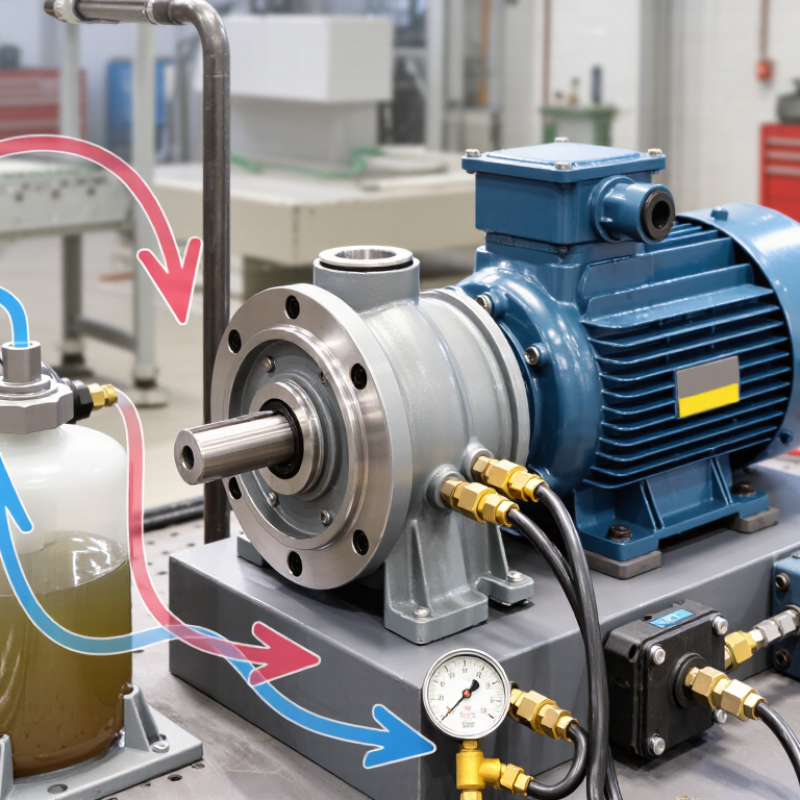
Motor selection also depends on torque, duty cycle, and heat rejection. Pump torque rises with pressure and displacement, so confirm the motor can handle continuous and starting loads. Classify operation as continuous, intermittent, or frequent cycling. A motor running for ten minutes every hour faces different thermal demands than one running all shift. Check ambient temperature, reservoir capacity, oil viscosity, and available electrical supply. Leave a sensible service margin, but avoid oversized motors. Excess capacity can increase energy use, heat, and operating cost. In practice, validate calculations with a pressure gauge, flow meter, and temperature reading. One detail is easy to miss. Acceleration, stalled actuators, and sudden load changes may briefly exceed the stated duty. If the application feels borderline, revisit the assumptions before ordering. The first estimate is rarely perfect.

Match Pump Type and Motor Speed: 750–3,600 rpm Selection Range

How to Choose the Right Hydraulic Pump Motor?

Match Pump Type and Motor Speed: 750–3,600 rpm Selection Range

Choosing a hydraulic pump motor starts with flow, pressure, displacement, and shaft speed. Speed matters. At 750 rpm, the system produces strong torque with gentle fluid movement. This range suits large-displacement pumps, mobile equipment, and applications needing quieter operation. However, the motor must deliver more torque for the same power output. That can increase its physical size and purchase cost.

At 1,450–1,800 rpm, many hydraulic systems reach a practical balance between torque, noise, efficiency, and motor size. Gear pumps often perform well in this range, provided their rated speed and pressure limits match. At 3,000–3,600 rpm, smaller pumps can provide high flow from compact packages. Yet high speed may increase heat, inlet losses, noise, and cavitation risk. Piston and vane pumps especially require careful review of their allowable rpm range.

A common mistake is treating 1,450 rpm as a universal answer. It is convenient, but not always correct. Check the pump datasheet, motor speed under load, coupling rating, oil viscosity, and suction-line size. Field measurements matter too. Listen for a sharp whine and inspect the oil temperature after steady operation. These signs can reveal a mismatch that calculations miss. I would also leave a modest safety margin instead of running continuously at the published maximum. Paper selection feels precise. Real machines are less forgiving.

Calculate Motor Power: kW = Pressure (bar) × Flow (L/min) ÷ 600η

How to Choose the Right Hydraulic Pump Motor?

Choosing a hydraulic pump motor starts with pressure and flow, not guesswork. Use this practical formula: kW = Pressure (bar) × Flow (L/min) ÷ 600η. The symbol η represents total efficiency, including pump, motor, and mechanical losses. If a system needs 180 bar and 40 L/min, with 0.85 efficiency, the calculation is 180 × 40 ÷ 600 × 0.85, or about 14.1 kW. Check the brackets carefully. A clearer version is kW = (Pressure × Flow) ÷ (600 × η).

Real operating conditions can change the result. Pressure may rise during cylinder acceleration, valve restriction, or cold starts. Flow can also vary with leakage and pump wear. I usually calculate the required power first, then allow a sensible service margin, often 10–20 percent. Too little capacity causes overheating and stalled starts. Too much capacity increases purchase cost, energy use, and mechanical stress. Bigger is not automatically better.

Confirm the motor’s rated power, speed, voltage, duty cycle, and starting torque. The pump must also match the motor shaft and required displacement. Review the worst expected pressure, not only the normal gauge reading. One overlooked detail is efficiency at partial load. It may be lower than the catalogue estimate. Measure actual current and temperature during commissioning when possible. The formula is reliable, but field conditions still deserve a second look.

Check Torque, Starting Load, and 70–350 bar System Compatibility

How to Choose the Right Hydraulic Pump Motor?

Choosing a hydraulic pump motor starts with torque, not pressure alone. Identify the machine’s load, shaft speed, and required displacement per revolution. A motor may operate at 250 bar, yet fail during startup if its starting torque is too low. Static friction, cold oil, and sudden loads can demand much more torque than normal operation.

Estimate theoretical torque with this practical formula:

torque in Nm equals pressure in bar multiplied by displacement in cc per revolution, divided by 62.8.

Then allow for mechanical efficiency and pressure losses.

For example, a 100 cc motor at 200 bar produces about 318 Nm theoretically. The real output will be lower.

I have seen sizing errors happen when designers use maximum pressure instead of continuous pressure. That shortcut needs reconsideration.

Tips:

  • Check both starting and running torque.
  • Confirm the motor’s continuous and intermittent pressure ratings.
  • The 70–350 bar range covers very different working conditions, so never assume one motor suits the entire range.
  • Verify flow, speed, shaft loading, case-drain requirements, and valve compatibility.
  • A pressure relief setting must protect the weakest component.
  • Test startup with the actual load, especially when oil temperature is low.
  • A motor that starts smoothly in a workshop may hesitate on a cold morning.
  • Use manufacturer data, measured system pressure, and service experience together before final selection.

Verify Efficiency, Thermal Limits, and IP55 Motor Protection Before Purchase

How to Choose the Right Hydraulic Pump Motor?

Efficiency deserves more than a catalog glance. The International Energy Agency estimates that electric motor systems use about 46% of global electricity. A small efficiency loss can therefore become a large operating cost. Check the motor’s rated efficiency at the pump’s real duty point, not only at full load. IEC 60034-30-1 efficiency classes help compare IE2, IE3, and IE4 motors consistently. However, a highly efficient motor can still perform poorly if the pump is oversized, frequently unloaded, or badly aligned.

Thermal limits are equally important. Read the insulation class, allowable ambient temperature, and duty rating. Class F insulation is designed for 155°C insulation-system temperature, but that is not a permission to operate continuously at extreme heat. Cooling airflow, hydraulic pressure, starts per hour, and enclosure conditions all affect winding temperature. The U.S. Department of Energy identifies motor systems as a major industrial energy load, so thermal efficiency deserves practical testing, not paperwork alone. A neat datasheet can still mislead.

IP55 means dust-protected and protected against water jets under IEC 60529. It does not mean waterproof. Confirm the installation’s washdown pattern, humidity, drainage, and cable-gland sealing. During commissioning, measure current balance, surface temperature, and vibration after the motor reaches operating temperature. Leave margin. I have seen motors pass a brief test, then overheat during repeated cycling. That overlooked detail can change the correct motor choice.

How to Choose the Right Hydraulic Pump Motor

Efficiency and calculated motor losses at a constant hydraulic output of 15 kW, assuming 90% pump efficiency.

Efficiency check

Higher motor efficiency reduces electrical input and operating losses. At 15 kW hydraulic output and 90% pump efficiency, the required motor shaft power is approximately 16.67 kW.

Thermal limit check

Confirm the rated ambient temperature, duty cycle, cooling method, and winding temperature rise. The insulation-system temperature limit must not be exceeded under continuous load.

IP55 protection check

IP55 indicates protection against dust ingress that could interfere with operation and protection against water jets from any direction. It is not suitable for immersion.

Choose a global leader for your hydraulics solutions

How can we help you?

Call to 0034 943884600 Contact us
Call us Contact us

We use cookies to ensure that we give you the best experience on our website. If you continue without changing your settings, we'll assume that you agree to receive cookies on the HINE website. For more information read our cookie policy page, click the link for more information.plugin cookies

ACEPTAR
Aviso de cookies