China Top Hydraulic Repair Shops for Global Buyers?

Choosing a hydraulic repair shop in China requires more than comparing hourly rates. Global buyers need evidence, technical discipline, and dependable communication. A leaking excavator valve may look simple, yet internal scoring, contaminated oil, or incorrect seal materials can cause repeated failure.

Hydraulic systems specialist John S. Cundiff has emphasized, “A hydraulic system is only as reliable as its contamination control.” That principle matters during every repair. A capable hydraulic repair shop should inspect pumps, cylinders, valves, hoses, and filtration circuits before recommending parts. It should provide test-bench results, repair photographs, material details, and a clear warranty. These records help buyers evaluate workmanship from thousands of miles away.

China offers many experienced repair facilities, but quality is not uniform. Some shops excel at mobile equipment. Others specialize in industrial presses, injection machines, marine systems, or servo hydraulics. The right choice depends on failure type, pressure range, required tolerances, and delivery expectations. Ask how technicians identify root causes. Ask whether repaired units receive load testing. Ask how packaging prevents corrosion during ocean transport.

A polished website is not proof. I have seen detailed promises weakened by vague inspection reports. That deserves reflection. Reliable suppliers welcome technical questions and admit repair limits. They explain lead times honestly, including delays caused by unavailable components. This guide examines leading Chinese repair shops for global buyers, focusing on practical experience, measurable quality, communication, documentation, and after-sales responsibility.

China Top Hydraulic Repair Shops for Global Buyers?

How to Map China’s Hydraulic Repair Market by Region and Equipment Type

China’s hydraulic repair market is best mapped by regional industry clusters, not by city rankings. The China Construction Machinery Industry Association reported 195,018 excavators sold in 2023, including 105,038 exports. This export share creates steady demand for inspection, remanufacturing, and warranty-support repairs.

The Yangtze River Delta suits buyers needing precision valve, pump, and cylinder work. Its dense manufacturing base supports machining, sealing, and hydraulic testing.

The Pearl River Delta is stronger in mobile equipment, ports, factory automation, and injection-molding systems.

Shandong and Henan offer practical support for loaders, agricultural machinery, presses, and heavy cylinders.

Sichuan and Chongqing deserve attention for mining, construction, and mountainous transport equipment.

Equipment type should guide supplier selection.

For excavators, request flow testing, pressure records, contamination control, and cylinder-bore measurements.

For industrial presses, verify response stability under repeated cycles.

The ISO 4406 cleanliness standard provides a useful benchmark, but many workshops still report test results inconsistently. That is a warning.

The China Hydraulic Pneumatic & Seals Industry Association also identifies construction machinery, industrial equipment, and agricultural machinery as major application areas in China’s hydraulic sector. Regional boundaries are not clean.

Some small workshops outsource grinding or coating, so buyers should audit the complete repair chain, not only the front office. Photographs of worn seals, serial-number records, and before-and-after test curves reveal more than polished catalogs.

Which Shops Repair Pumps, Motors, Valves, and Cylinders

China Top Hydraulic Repair Shops for Global Buyers?

Which Shops Repair Pumps, Motors, Valves, and Cylinders

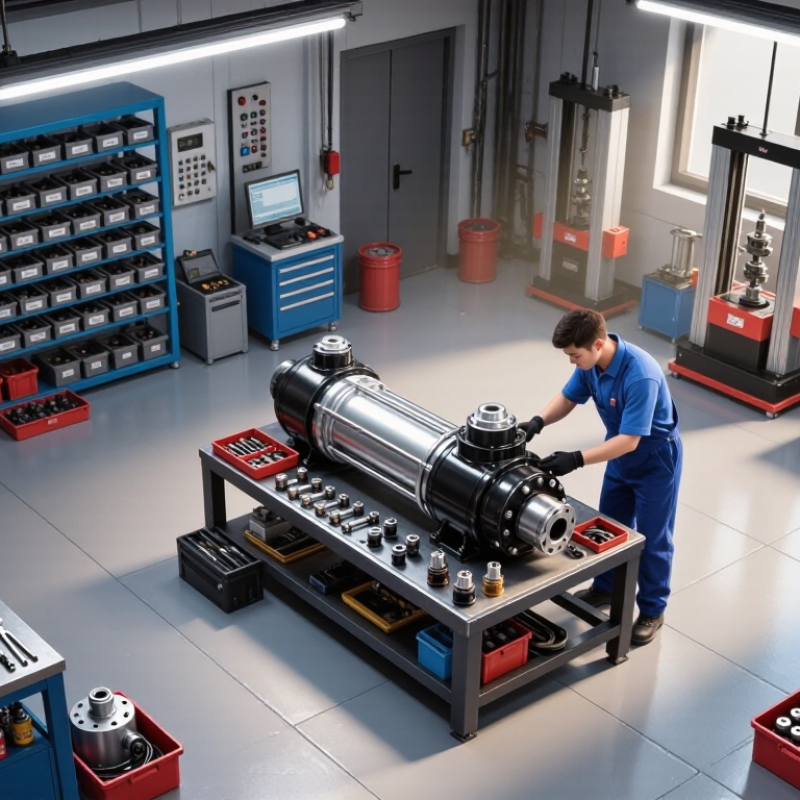
Reliable hydraulic repair shops in China usually handle pumps, motors, valves, and cylinders under one roof. Their teams inspect worn parts, measure clearances, and test pressure before recommending repairs. A serious workshop should provide inspection photos, test records, and a clear list of replaced components.

Pump and motor repairs often require contamination checks, shaft inspection, bearing replacement, and controlled performance testing. For valves, technicians examine spool movement, sealing surfaces, springs, and internal leakage. Cylinder specialists check rod straightness, tube wear, gland condition, and seal compatibility. Small defects can create large pressure losses.

Ask whether the shop owns calibrated test benches. This matters.

Experienced repair teams can explain failure causes, not only replace damaged parts. They may identify dirty oil, misalignment, overheating, or incorrect assembly. Global buyers should request dimensional reports, material details, warranty terms, and export-safe packaging. Clear communication prevents expensive misunderstandings.

Still, no workshop diagnoses every unit correctly on the first attempt. A repaired pump may need adjustment after installation. Some cylinders also require field alignment checks. Buyers should share operating pressure, fluid type, temperature, and application details before shipping equipment. A low quotation can hide limited testing, reused components, or weak documentation. Careful comparison is necessary.

How to Compare Test-Bench Capacity: P(kW) = Pressure(bar) × Flow(L/min) ÷ 600

For global buyers comparing hydraulic repair shops in China, test-bench power is a useful starting point, not a complete quality measure. The estimate P(kW) = pressure(bar) × flow(L/min) ÷ 600 converts hydraulic output into kilowatts. A pump tested at 280 bar and 120 L/min needs about 56 kW of hydraulic output. The drive motor and cooling system may require additional capacity. ISO 4409:2007 specifies methods for testing hydraulic pumps and motors, including measurements of flow, pressure, speed, and temperature. Ask whether a shop’s stated capacity applies continuously or only briefly. That distinction matters.

Tips: Request a sample test sheet showing pressure, flow, oil temperature, and rotational speed. Check whether the bench can safely reach your component’s rated conditions. A large motor alone proves little. A mismatched fixture or unstable oil temperature can distort results. I would also compare calibration records, though paperwork cannot replace a witnessed test.

For a repair involving a variable-displacement pump, ask for readings at several operating points, not just one peak-power figure. Confirm the bench can reproduce the required flow and pressure together; separate maximum ratings may never occur simultaneously. ISO 4409 provides a useful testing reference, but it does not certify every repair shop. Some limits remain unclear until the actual component is mounted and tested.

Comparing Hydraulic Test-Bench Power Capacity

Theoretical hydraulic power at selected pressure and flow test points. Power is calculated as P (kW) = Pressure (bar) × Flow (L/min) ÷ 600.

These calculations represent hydraulic output power only; they do not include pump, motor, or system losses. When comparing test benches, confirm the required pressure and flow can be sustained simultaneously.

How to Check Fluid Cleanliness Against ISO 4406 and Safety Against ISO 4413

China Top Hydraulic Repair Shops for Global Buyers?

When assessing a hydraulic repair shop, ask how it controls fluid cleanliness, not just how quickly it replaces parts. ISO 4406:2021 classifies solid-particle contamination by counting particles at three sizes: 4, 6, and 14 micrometres. The code is not a cleanliness grade by itself; the equipment maker’s target matters. Request a fluid sample report showing the code, sampling point, and test date. A sample taken from a quiet reservoir can hide debris circulating through a working circuit. That detail is easy to miss.

Contamination has costly consequences. A frequently cited industry estimate, reported by Machinery Lubrication, attributes roughly 70% of hydraulic-system failures to contamination. Treat that figure as a warning, not a guarantee for every machine. Ask whether the shop flushes hoses and manifolds, replaces filters, and verifies cleanliness before commissioning. ISO 4413:2010 addresses hydraulic-system safety, including pressure hazards, stored energy, and protection against leakage. Look for documented pressure testing, guarded test areas, and clear isolation procedures. A clean sample is useful. A safe test record is better. Even careful workshops can overlook a trapped pocket of fluid, so ask how they check dead legs and confirm the final sample reflects the repaired circuit.

China Top Hydraulic Repair Shops for Global Buyers? — How to Check Fluid Cleanliness Against ISO 4406 and Safety Against ISO 4413
Evaluation Area What to Check Evidence to Request How to Assess the Result
Fluid cleanliness code Ask for particle counts reported as an ISO 4406 code for particles larger than 4, 6, and 14 μm(c), expressed as three code numbers. A dated laboratory or calibrated particle-counter report identifying the sample, sampling point, test method, and reported code. Compare the measured code with the cleanliness target specified by the equipment or component manufacturer. ISO 4406 provides a coding method; it does not set one universal cleanliness target for every hydraulic system.
Representative sampling Check that the sample was taken from a suitable point in a circulating system using a documented, contamination-controlled procedure. Sampling location, operating conditions, flushing and bottle-handling steps, date, and sample identification. ISO 4021 covers extraction of fluid samples from operating hydraulic systems. Do not rely on an unlabelled sample taken from an open reservoir or an unclean container; poor sampling can distort particle-count results.
Particle-count measurement Confirm that the measurement method and instrument are suitable for the fluid and the required particle-size range. Instrument identification, calibration information, test method, and any notes about water, air bubbles, or other conditions that may affect the measurement. Check that results are reported consistently and that any unusual or suspect readings are investigated or confirmed with an appropriate repeat test.
Filtration and flushing Review the filtration and flushing plan used after repair, including filter condition, filter rating, and the cleanliness target for the serviced circuit. Flush procedure, filter details, and post-flush particle-count results from a representative sample. Accept the work against the equipment maker’s specified target and agreed test conditions. A filter rating alone does not demonstrate that the complete system has reached its target cleanliness.
ISO 4413 safety review Check whether the repair and return-to-service process addresses applicable hydraulic-system safety requirements, including foreseeable hazards from pressure, movement, and stored energy. Documented inspection or risk-review records, safe isolation and pressure-release steps, and a controlled test procedure. Assess against the applicable requirements of ISO 4413, the machine design, and the equipment maker’s instructions. ISO 4413 is a general safety standard for hydraulic fluid power systems, not a repair-shop certification.
Pressure and function testing Confirm that any pressure or function test is authorized for the component and performed with suitable guarding and controlled access. Approved test procedure, test conditions, results, and a record of leaks, abnormal noise, temperature, or other observed issues. Use limits and procedures specified by the equipment or component manufacturer. Do not treat a generic pressure value as appropriate for every repaired unit.
Contamination control during repair Ask how ports, hoses, components, and replacement parts are protected from dirt and moisture during disassembly, repair, storage, and reassembly. Work instructions or inspection records showing cleaning, component protection, and handling controls. Look for a documented process that prevents contamination from being introduced after cleaning or flushing.
Traceability and reporting Check whether the repair record links the serviced unit to its inspection findings, replaced parts, test results, and cleanliness results. A job report with a unique job reference, dates, work performed, measurements, and any stated limitations or deviations. Prefer complete, attributable records that allow the buyer to verify what was tested and which acceptance criteria were used.

Important: Cleanliness targets and safe test limits depend on the specific hydraulic system and components. Confirm acceptance criteria with the equipment manufacturer and the applicable technical documentation before repair or commissioning.

How Global Buyers Evaluate Export Support, Warranties, and Service Coverage

For global buyers, a hydraulic repair shop’s export support matters as much as its technical skill. The World Bank’s 2023 Logistics Performance Index assessed 139 economies across six areas, including shipment tracking and timeliness. Its findings underline a practical point: delays can occur beyond the workshop door. Ask for packing specifications, export documents, shipment updates, and a named contact before approving a repair.

Warranty terms should state what is covered, for how long, and how claims are handled across borders. Request a sample inspection report with measured tolerances, replaced-part details, and test results. Confirm whether the shop can provide local service partners or remote troubleshooting in your region. A polished promise is not proof. I would also check response times against recent references; sometimes the paperwork looks stronger than the actual follow-up.

Tips: Ask for one recent export case similar to yours. Get the warranty exclusions and freight responsibilities in writing. Confirm service coverage by country, not just by region. A brief video call can reveal how clearly technicians explain a failure—and where their support may fall short.

Choose a global leader for your hydraulics solutions

How can we help you?

Call to 0034 943884600 Contact us
Call us Contact us

We use cookies to ensure that we give you the best experience on our website. If you continue without changing your settings, we'll assume that you agree to receive cookies on the HINE website. For more information read our cookie policy page, click the link for more information.plugin cookies

ACEPTAR
Aviso de cookies